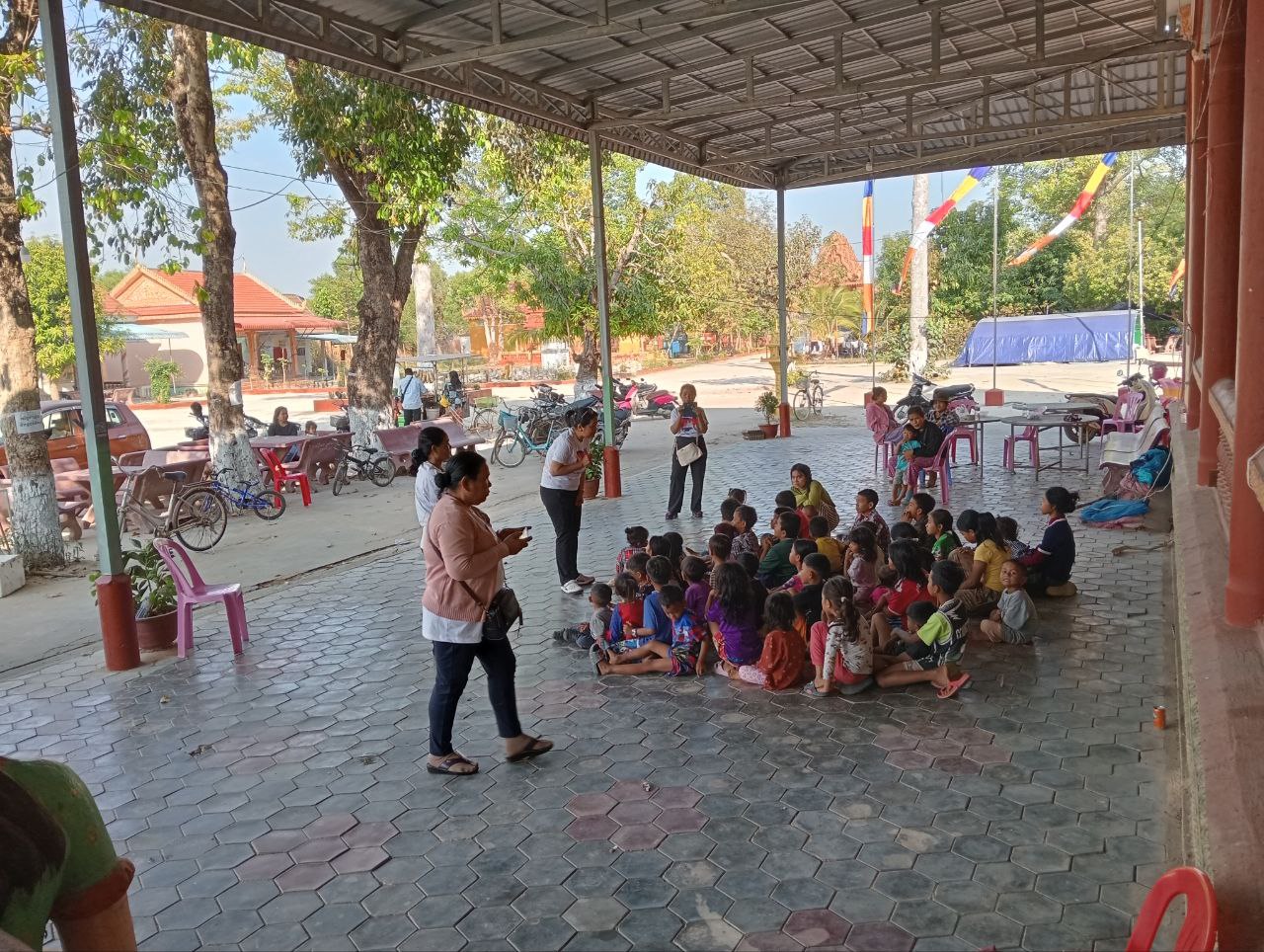
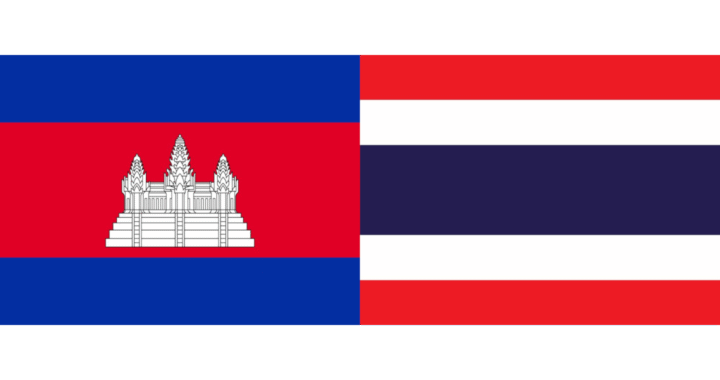
CCC’s Country Director joined members of a Phnom Penh church to take much-needed relief supplies to refugees from the fighting between Cambodia and Thailand. The refugees were sheltering in a Buddhist pagoda in Siem Reap province.
Unloading suppliesRefugee children
The team also met Cambodian soldiers who were weary of fighting and just wanted to go home to their families.
Fighting between Cambodia and Thailand resumed on 7 December.
At first there was only a brief exchange of small arms fire and the use of grenade launchers and mortars at one location, but the fighting intensified with the use of artillery by both sides and air strikes by the Thai air force, and the conflict spread to several locations along the border between the two countries.
The Thai army’s stated objective was to “cripple Cambodia’s military capability”, ostensibly to ensure that Thailand could be assured of defending its territory, but prompting concerns that it was seeking military superiority in order to occupy and absorb disputed areas, or even grab land from Cambodia.
Thai F16 aircraft bombed several civilian targets, including some near locations where refugees were sheltering.
On 27 December, the two countries signed another ceasefire agreement, and four days later, 18 Cambodian prisoners of war that Thailand had been holding since July were repatriated.
On 18 October, Prak Sokhonn, Cambodia’s Minister of Foreign Affairs, announced that Cambodia and Thailand had successfully negotiated a comprehensive peace deal aimed at normalising relations and ensuring border stability.
Sokhonn said that the two countries had agreed to rebuild diplomatic ties, remove heavy weapons from the border and clear landmines in a joint operation. Thailand has also agreed to release 18 captured Cambodian soldiers immediately, he said.
The final peace deal is expected to be formally signed by both countries, with President Trump serving as the witness, later in October.
Following the agreement on 28 July between the Cambodian Prime Minister and the Thai Acting Prime Minister to implement an “immediate and unconditional ceasefire”, hostilities on the ground largely ceased. On 7 August, a General Border Committee meeting was held in Kuala Lumpur, at which the two sides agreed to a 13-point agreement that included the cessation of all hostilities, avoidance of military provocation, protection of civilians and the maintenance of bilateral communication.
Monitors from the Association of Southeast Asian Nations (ASEAN) and diplomats from other nations have made inspection visits to the border.
Thailand returned two injured Cambodian soldiers but retained a further 18 in captivity. Four Thai soldiers were injured by landmines in the disputed border area. The Cambodian Ministry of National Defence has claimed that Thai forces have crossed into Cambodian territory to lay barbed wire.
Some displaced persons have returned home, but thousands of Cambodians who fled from their homes near Ta Moan and Ta Krabey temples remain in camps.
Airstrikes by Thailand and shelling by both sides continued. Civilian populations of both countries were evacuated from border areas.
Acting Prime Minister of Thailand Phumtham Wechayachai stated that the conflict could turn into a full scale war if the situation worsened. Thailand rejected the proposal of mediation from a third country to end the fighting, opting to resolve the situation only through bilateral talks.
26 and 27 July
Fighting continued, spreading to other parts of the border. The death toll climbed to at least 32, including 21 civilians.
President Donald Trump spoke to the Prime Minister of Cambodia and Acting Prime Minister of Thailand, threatening not to conclude a trade deal with either country if it continued fighting. Both leaders then accepted an invitation from the Prime Minister of Malaysia, Anwar Ibrahim, to participate in peace talks mediated by him on 28 July.
28 July
Shelling began at 03:00. A spokesperson for the Cambodian defence minister accused Thai forces of using chemical weapons. This was denied by the Thai Ministry of Foreign Affairs.
Peace talks were convened in Malaysia. As well as the leaders of Cambodia and Thailand, representatives of the USA and China were present. Agreement was reached on an “immediate and unconditional ceasefire” with effect from 23:59 ICT on 28 July. At 7:00 on 29 July, military commanders and defence attachés would meet, and a border committee meeting would be held on 4 August. The Association of Southeast Asian Nations will be involved in a process to ensure the ceasefire lasts.
For further information on the outcome of the negotiations, see this report from Channel News Asia.